Shohei Ohtani PSA 10 vs Raw: Is It Worth Grading?
The buy-and-grade decision for Shohei Ohtani cards — how much a PSA 10 really adds over a raw copy, when grading pays off and when it burns money, and how to read the graded-vs-raw gap on live eBay comps before you commit.
Every value conversation about Shohei Ohtani cards eventually hits the same fork in the road: raw or slabbed? The same card — the same year, the same set, the same parallel — can trade for one price loose in a sleeve and a very different price sealed in a PSA 10 holder. This page is about that gap: how big it really is, when grading a card is worth the cost, and when it quietly loses money. Every price you reach through the buttons here is a live eBay listing or sold comp, never a number we invented — because on the grade-vs-raw question, the comps are the only honest answer.
What “PSA 10 vs raw” actually means
A raw card is ungraded — it’s the card as it came out of the pack, in a sleeve or toploader, with its condition left to your own eyes and the seller’s photos. A graded card has been sent to a third-party grader (PSA, SGC, BGS), authenticated, assigned a numeric grade, and sealed in a tamper-evident slab. A PSA 10 — Gem Mint is the top of PSA’s scale: near-perfect centering, corners, edges, and surface.
The slab does three things a raw card can’t. It authenticates (a real concern on Ohtani, one of the most counterfeited names in the hobby). It freezes condition — no more corner dings from handling. And it removes the argument — a graded 10 is a 10 to every buyer, while a raw “mint” card is one collector’s opinion against another’s. Those three things are what the graded premium pays for.
How big is the graded-vs-raw gap?
There is no single multiplier, and anyone who quotes you a flat “a PSA 10 is worth X times raw” is guessing. The real pattern is this: the graded premium widens as the card gets scarcer and harder to grade.
- On a plentiful base rookie that gems easily, the PSA 10 premium over raw is often modest — sometimes barely more than the cost of grading itself. The market is deep, plenty of 10s exist, and the slab adds convenience more than scarcity.
- On a condition-sensitive Chrome card — a refractor, a numbered parallel — the gap stretches, because Chrome corners and surfaces are notoriously hard to keep gem-mint, so far fewer copies ever hit a 10.
- On a low-population auto or a marquee chase — his 2018 Bowman Chrome Rookie Autograph (BCRA-SO), a scarce coloured refractor — the top-grade copy can trade for a large multiple of the raw card, because the grade multiplies an already-scarce card.
That’s the whole logic in one line: grading pays in proportion to how hard the card is to grade. For the full picture of where Ohtani’s value actually concentrates, see the most valuable Ohtani cards ranking; for how the color ladder feeds into all of this, the refractors and parallels guide maps every tier.
The PSA 9 cliff — the number that breaks the math
Here’s the trap that catches new graders. Everyone runs the math on a PSA 10. Almost nobody runs it on a PSA 9 — and a 9 is what a strong-but-imperfect card usually comes back as.
On marquee Ohtani cards, and on Chrome especially, the jump from a 9 to a 10 is frequently a cliff, not a step: the 10 can sell for a large premium while the 9 sells much closer to raw. So if you grade a card that looks great but isn’t truly flawless, you can pay the full fee, wait weeks, and receive a slab worth only a little more than the raw card you started with. The premium you were chasing lived entirely in the 10.
That’s why the honest question before submitting is never “how much is the 10 worth?” — it’s “is this genuinely a 10?” Pull up the 9 and the 10 comps side by side (the rails below let you) and be ruthless about which one your card really is.
When grading is worth it — and when it isn’t
Grade it when:
- The card is genuinely gem-mint — dead-center, sharp corners, clean surface — under strong light and magnification.
- The PSA 10 premium comfortably clears the grading fee, shipping, and return shipping, with margin left over.
- It’s a scarce, condition-sensitive, or signed card (refractor, numbered parallel, auto) where the grade multiplies real scarcity.
Leave it raw when:
- The card is strong but not perfect — a likely 9 — and the 9 comps sit close to raw.
- It’s a common base card where the 10 premium barely covers the fee.
- You’re buying to keep, not resell, and the slab’s liquidity and authentication don’t matter to you.
Run the actual break-even instead of eyeballing it: our grading ROI calculator takes the raw price, the graded price, and the grading cost and tells you whether the submission clears — and centering is the grade-killer most people misjudge, so check it on the card centering tool before you send anything in.
Buying the decision instead of making it
If you’d rather skip the condition risk entirely, buy the slab. A PSA 10 Ohtani is a finished card: authenticated, condition-locked, and the most resale-liquid form the card comes in. You pay the graded premium, but you carry none of the “will it come back a 10?” risk — and gem-mint slabs are the easiest Ohtani cards to move when you sell.
If you’d rather chase value, buy raw and grade selectively — but only a copy clean enough that a 10 is realistic, and only when the graded comps justify it. The raw route can be cheaper per dollar of eventual value, but the fee and the condition risk are yours.
Either way, the move is the same: pull the sold comps first. The rails below open live eBay listings for the exact grades that decide this — raw rookies, the PSA 9 below, and the PSA 10 above — plus the graded refractor, auto, and Bowman/Topps Chrome markets where the grade-vs-raw gap is widest. Tracking a whole graded run over time? Log them in the collection value tracker. And if you’re still sorting out which of his cards are the ones worth grading in the first place, start with the Ohtani rookie card guide and what an Ohtani card is worth.
Find these cards on eBay
The cards on this list trade on eBay, not Amazon — these open live listings for each one. Buy graded (PSA or SGC) for anything above four figures.
Products Featured on This List
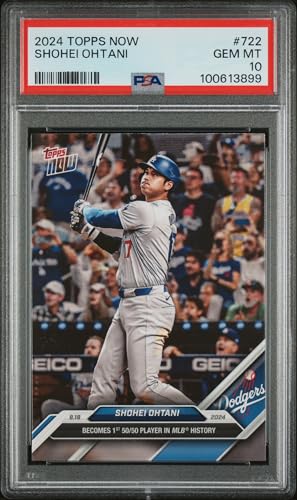
Shohei Ohtani 2024 Topps Now Baseball Card #722 (Cert. #100613899) 1st 50/50 Milestone, PSA 10 GEM MINT Graded & Authenticated
Shohei Ohtani 2024 Topps Now Baseball Card #722 (Cert. #100613899) 1st 50/50 Milestone, PSA 10 GEM MINT Graded & Authenticated. Professionally graded and authenticated for guaranteed condition.
- Professionally graded
- Authenticated condition

2025 Topps Now SHOHEI OHTANI Greatest Game in Playoff History NLCS 10 Strikeouts and 3 Homeruns Card #884 - Graded GEM-Mint 10
2025 Topps Now SHOHEI OHTANI Greatest Game in Playoff History NLCS 10 Strikeouts and 3 Homeruns Card #884 - Graded GEM-Mint 10. Professionally graded and authenticated for guaranteed condition.
- Professionally graded
- Authenticated condition

2024 Topps Now #722 Shohei Ohtani Baseball Card Dodgers Graded PSA 10 Gem Mint - 1st 50/50 Player
2024 Topps Now #722 Shohei Ohtani Baseball Card Dodgers Graded PSA 10 Gem Mint - 1st 50/50 Player. Professionally graded and authenticated for guaranteed condition.
- Professionally graded
- Authenticated condition