Best Sealed Boxes to Pull a Shohei Ohtani Card (2026 Buyer's Guide)
Which sealed baseball products can actually contain a Shohei Ohtani card, what hobby vs. mega vs. blaster really changes, the five sealed-box traps to avoid — and when buying the single beats ripping for it.
Our Top Picks at a Glance

Casual collectors and gift giving

Casual collectors and gift giving
Protecting your collection
| # | Product | Availability | Best For | |
|---|---|---|---|---|
| 1 | $31.99 In Stock at Amazon | Casual collectors and gift giving | ||
| 2 | $22.83 In Stock at Amazon | Casual collectors and gift giving | ||
| 3 | $24.99 In Stock at Amazon | Protecting your collection | Buy on Amazon
Prime Eligible
|
If you’d rather pull an Ohtani card than buy the single, sealed baseball boxes are the way to do it — just go in understanding what sealed product can and cannot contain. This page covers which sealed families can actually carry him, what each box format really changes, the five traps that cost box buyers the most money, and the honest point at which buying the single wins.
Reality check first
The math is unsentimental: pulling one named player from a box is a long shot, and pulling that player’s autograph is a much longer one. Manufacturers build odds against the whole checklist, not against Ohtani.
If you specifically want an Ohtani card, buying the exact single is cheaper and far more reliable than chasing it through wax — see what his cards are worth and the rookie card map for what to target. Rip boxes for the experience; buy singles when you want the card.
The rule that costs box buyers the most money
A card carries the year it was printed. Ohtani’s rookie cards are 2018-dated, from his first MLB season with the Angels, and they exist only in 2018 product. No 2026 box contains a 2018 rookie card. What a modern box can contain is a modern Ohtani card, an insert that depicts his earlier seasons, or occasionally a buyback — all of which are different cards from the rookie.
So decide which of these you actually want before you spend anything:
| What you want | Where it lives | What to do |
|---|---|---|
| His 2018 rookie cards | 2018-dated product only | Buy the single — flagship #700 paper, Topps Chrome RC |
| His 1st Bowman Chrome prospect auto | 2018 Bowman Chrome only | Buy the single — the marquee chase |
| A current-era Dodgers Ohtani | This year’s Topps products | Rip a box, or buy the Dodgers single |
| A Topps Now moment card | Print-to-order, sold direct | Secondary market only — Topps Now guide |
| A numbered parallel or auto | Hobby product, long odds | Buy the parallel or autograph you want |
Which sealed families can carry him
Topps holds the current MLB license, so anything with real team logos and a current Ohtani in Dodger blue is a Topps product. That shapes the whole shelf:
- Topps flagship (Series 1, Series 2, Update) — the base annual set. Highest card count, so the best straight odds of an Ohtani base card or a parallel, and the cheapest way to rip.
- Topps Chrome — the chromium version of flagship, built on the refractor rainbow. The finish collectors chase; fewer cards per box than flagship, better parallel density. Our refractor and parallel explainer covers what the colors mean.
- Bowman / Bowman Chrome — prospect-driven by design. His 1st Bowman era ended in 2018, so modern Bowman is not where you go looking for an “Ohtani rookie”; he appears in the veteran portion when included at all.
- Premium and mid-tier Topps products — Stadium Club, Heritage, Allen & Ginter, Museum and the high-end lines each have their own look and their own hit structure. Star veterans on a marquee team are routinely in these checklists.
- Older Panini (Donruss, Prizm, Select) — from the unlicensed era, so no team logos. Real Ohtani cards, different look, generally softer demand than licensed Topps.
Always confirm against the published checklist for that exact product and year before you buy a box for one player. Checklists move year to year, and a player being in last year’s product proves nothing about this year’s.
What box format actually changes
Format changes hit structure, not luck:
- Hobby — sold through card shops and hobby distributors. Normally states a per-box guarantee (an autograph or relic) printed on the box. That guarantee is for someone on the checklist, never for a named player.
- Jumbo / HTA — hobby packs with more cards per pack and usually a heavier stated guarantee. Fewer packs, more content per pack.
- Mega boxes — retail, and the format most rippers pick. No hit guarantee as a rule, but they carry retail-exclusive parallels in colors you cannot pull from hobby product.
- Blaster and value boxes — the cheap, casual rip. Retail-exclusive inserts or parallels, low card count.
- Hangers and rack packs — the smallest buy-in, often with one exclusive parallel colour of their own.
- Factory / complete sets — sealed, and the only sealed format where you know exactly what is inside, because the base set is the whole product.
The single most useful habit: read the guarantee printed on the box instead of assuming from the format. It changes product to product and year to year.
Five sealed-product traps
- Repacks and “mystery boxes.” Assembled by third-party sellers, not manufacturers — no published checklist, no odds, no accountability. A star’s name in the listing title is marketing, not a guarantee.
- “Guaranteed autograph” wording. It guarantees an autograph of somebody on the checklist. Reading it as “an Ohtani auto” is the most expensive misread in the hobby.
- Vintage-era wax bought for a specific rookie. Old sealed product carries real resealed-and-searched risk, and the odds on one named card are worse than simply buying that card.
- Team sets and gift packs with vague contents. These are genuinely fun and cheap, but contents vary by listing — read the actual card list before you buy if a specific card matters to you.
- Paying box money for single-card value. Before you rip, price the card you’re chasing against recent sold comps. If the single costs less than the box, the box is entertainment, and that’s a fine reason to buy it — just buy it knowingly.
Sealed and semi-sealed picks that are actually in stock
Availability is checked daily; these are the current in-stock options that are honest about what they contain rather than selling a name.
- 2019 Topps #600 Shohei Ohtani Baseball Card - Topps All-Star… — a sealed set from his rookie season, listed as a 17-card Angels team set. Period-correct 2018 Angels cardboard in a format where the contents are the whole set, not a lottery.
- Ohtani, Betts, Freeman | LA Baseball MLB Player | MLBOHT3001… — a hand-assembled Ohtani-only pack spanning both teams. The lowest-friction way to hand somebody real Ohtani cards.
- Ohtani 5-card assorted gift pack (Angels) — the Angels-era version of the same idea.
- Ohtani 10-card assorted gift pack (Angels) — twice the cards, same premise.
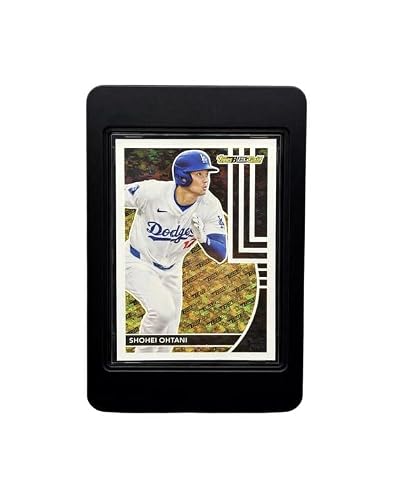
- 35pt magnetic card holder — buy this before you rip. The damage that kills a card’s grade happens in the first five minutes out of the pack.
Browse the full shelf by format: hobby boxes · mega boxes · value boxes · complete sets · graded singles · supplies. New product drops are tracked on the release calendar.
You pulled one. Now what?
- Sleeve it immediately, then top loader or magnetic holder. Do not slide it across the table to show someone first.
- Identify it properly — year, set, card number, parallel, and any serial number printed on the card. The collector’s map explains how the pieces fit together.
- Check comps before you get excited or dismissive. Sold prices, matched on all five of year, set, card number, parallel and grade.
- Decide on grading with the math, not the feeling — the grading ROI calculator and the PSA 10 vs. raw breakdown tell you when a fee is worth paying, and the centering tool tells you whether the card even has a shot.
- Log it in the collection value tracker so you know what you own.
New to all of this? Start with the beginner’s guide, then the Ohtani collecting guide for lane-by-lane advice on what to buy first.
Live Ohtani auctions ending soon
LIVEReal-time eBay auctions · bids shown are current · tap a card to bid on eBay
Skip the odds — buy the card on eBay
Sealed wax, singles, autos and graded slabs all trade on eBay. These open live listings for each type — check recent sold comps before you bid or hit Buy It Now.
All Products in This Roundup
2019 Topps #600 Shohei Ohtani Baseball Card - Topps All-Star Rookie
2019 Topps #600 Shohei Ohtani Baseball Card - Topps All-Star Rookie. Great value retail product perfect for casual collectors and pack rippers.
- Great retail value
- Multiple packs included
Ohtani, Betts, Freeman | LA Baseball MLB Player | MLBOHT3001 T-Shirt
Ohtani, Betts, Freeman | LA Baseball MLB Player | MLBOHT3001 T-Shirt. Great value retail product perfect for casual collectors and pack rippers.
- Great retail value
- Multiple packs included

Shohei Ohtani (5) Assorted Baseball Cards Gift Pack - Los Angeles Angels Trading Cards
Shohei Ohtani (5) Assorted Baseball Cards Gift Pack - Los Angeles Angels Trading Cards. Great value retail product perfect for casual collectors and pack rippers.
- Great retail value
- Multiple packs included

Shohei Ohtani (10) Assorted Baseball Cards Gift Pack - Los Angeles Angels
Shohei Ohtani (10) Assorted Baseball Cards Gift Pack - Los Angeles Angels. Great value retail product perfect for casual collectors and pack rippers.
- Great retail value
- Multiple packs included
Magnetic Sports Card Holder 35pt – Premium Trading Card Display Case with UV Protection & Slide-Lock Design by M1NT (M1NT Signature)
Magnetic Sports Card Holder 35pt – Premium Trading Card Display Case with UV Protection & Slide-Lock Design by M1NT (M1NT Signature). Essential supplies to protect and display your card collection.
- Protects your collection
- High quality materials